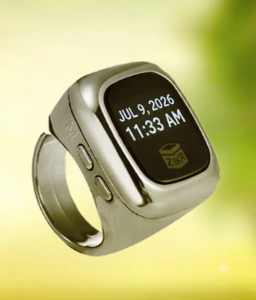


Losing count of laps is one of the most common frustrations in running, swimming and walking. You start strong, your mind drifts somewhere around lap seven, and suddenly you can’t remember whether you’re on eight or nine. Guessing either cuts your workout short or adds distance you didn’t plan for.
This guide explains how to count laps reliably on a running track, in a swimming pool and on a walking loop, how many laps make common distances, and the simple habits that stop you losing count.
Why Lap Counting Goes Wrong
Counting in your head works for a few laps, but it competes with everything else your brain is doing: pacing, breathing, technique and simply getting tired. The usual problems are:
- Drifting attention: long sets are repetitive, so your mind wanders and the number slips.
- Fatigue: the harder the effort, the less reliable your memory becomes — usually right when the count matters most.
- Counting at the wrong moment: some people count when they start a lap, others when they finish one, and switching between the two adds or drops a lap.
- Unclear terms: in swimming, “lap” can mean one length of the pool or there and back, depending on who you ask.
The fix is to take the counting out of your head and put it on a counter — a button press, a tap on a screen or a mark on paper — at the same point on every lap.
How to Count Laps on a Running Track
A standard outdoor track measures 400 metres per lap in lane 1, measured along the inside edge. Indoor tracks are usually shorter, most often 200 metres.
Set up your count
- Pick a fixed counting point, such as the start/finish line or a lamp post beside the track, and count only when you pass it.
- Press once per completed lap, not when you start one. Start the counter at zero and your first press means “one lap done”.
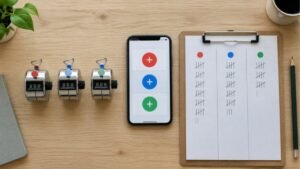
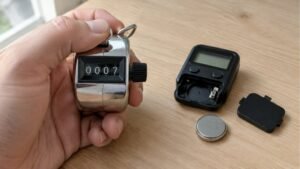
- Use a handheld clicker or your phone. A small mechanical counter is easy to press mid-stride without looking. If you carry a phone, our free online tally counter works in the browser with no app to install.
- Stay in the same lane. Each lane further out adds distance to every lap, so switching lanes changes how far you’ve really gone.
How many laps is a mile or a kilometre?
| Distance | 400 m track (lane 1) | 200 m indoor track |
|---|---|---|
| 1 km | 2.5 laps | 5 laps |
| 1 mile (1,609 m) | 4 laps + about 9 m | 8 laps + about 9 m |
| 5 km | 12.5 laps | 25 laps |
| 10 km | 25 laps | 50 laps |
Four laps of lane 1 make 1,600 metres, about 9 metres short of a true mile. For most training that difference doesn’t matter, but if you want an exact mile, start about 9 metres behind the finish line. Outer lanes are longer: a lap in lane 2 is roughly 408 metres and in lane 8 roughly 454 metres, so four laps in lane 8 add more than 200 metres.
How to Count Laps in a Swimming Pool
Swimming makes counting harder: you can’t hold a phone, your face is in the water, and turns come quickly. Settle the terminology first, then pick a method that works wet.
Length or lap?
A length is one trip from one end of the pool to the other. A lap is usually two lengths — there and back — although many swimmers and pools use “lap” to mean a single length. Decide which one you’re counting before you start, and stick with it. Counting lengths is the safer choice, because a length always has the same distance.
Ways to keep count in the water
- Waterproof lap counter: a finger-worn or wall-mounted counter you press at each wall. This is the most hands-free option.
- Poolside helper: a coach, friend or parent counts on a phone or clicker while you swim — useful for children’s lessons and training sets.
- Break it into small sets: swim in blocks of four or five lengths and rest briefly at the same end. Counting to four is far easier than counting to forty.
- Objects at the end of the lane: line up a few small items (with the pool’s permission) and move one across after each set.
How many lengths make common distances?
| Distance | 25 m pool | 50 m pool | 25 yd pool |
|---|---|---|---|
| 1 km | 40 lengths | 20 lengths | about 44 lengths |
| 1,500 m | 60 lengths | 30 lengths | about 66 lengths |
| 1 mile | about 64 lengths | about 32 lengths | about 70 lengths |
You may also hear about the “swimmer’s mile”. That’s the 1,650-yard race, which is 66 lengths of a 25-yard pool and a little short of a true mile, or the 1,500-metre race, which is 60 lengths of a 25-metre pool.
How to Count Laps When Walking
Walking laps — around a park, a sports field, a shopping centre or even your garden — follows the same rule: one fixed counting point and one press per completed loop.
- Measure the loop once. Walk it with a GPS watch or measure it on a map, then multiply by your lap count instead of tracking distance every time.
- Keep the counter in your hand or pocket. A clicker or an open browser tab on your phone means one press as you pass your marker.
- Walking with others? Let one person count for the group so you don’t end up with three different totals.
Counting Laps for Someone Else
Coaches, PE teachers and event volunteers often count laps for several runners or swimmers at once — for example, in a school fun run or a charity walk. Give each person their own counter so totals never mix:
- Open the online tally counter and use Add counter to create one counter per participant.
- Name each counter with the person’s name or bib number.
- Stand at the counting point and press each person’s + button as they pass.
- If you tap the wrong person, press − on their counter and add the lap to the right one.
For larger groups, split the participants between two or more counters. Our guide on how to count several things at once covers more set-ups for keeping categories apart.
Tips to Never Lose Count
- Count completed laps only. Press as you finish each lap, never as you start one.
- Use the same marker every time. One fixed point removes the “did I already count this one?” doubt.
- Plan in blocks. Twelve laps feels easier as three sets of four, and you can check the counter after each set.
- Check the counter, not your memory. If your memory and the counter disagree, trust the counter — that’s what it’s for.
- Write down the total afterwards. Note laps and distance in a training log before you reset.
Not sure whether a handheld clicker or a digital counter suits you better? See What Are the Different Types of Tally Counters? If you plan to count on your phone, Can I Use a Tally Counter on My Phone? explains what to expect.
FAQs
How many laps around a track is a mile?
Four laps of a standard 400-metre track in lane 1, which is 1,600 metres — about 9 metres short of a full mile. On a 200-metre indoor track it’s eight laps.
Is a lap in swimming one length or two?
It depends on who you ask. Strictly, a lap is two lengths (there and back), but many swimmers use “lap” for one length. To avoid confusion, count lengths.
Can I use my phone as a lap counter?
Yes, for running and walking. Open the online tally counter in your browser and tap + after each lap. In the pool, a waterproof lap counter or a poolside helper is more practical.
What if I miss a press?
If you’re sure you missed one, add it at the next counting point. If you’re not sure, use your watch: divide the elapsed time by your usual lap time to estimate where you are, then finish the set and note the uncertainty in your log.
Conclusion
Accurate lap counting comes down to three habits: count at one fixed point, press only when a lap is complete, and let a counter do the remembering. Use a clicker or your phone on the track and on walks, a waterproof counter or a helper in the pool, and one named counter per person when you’re counting for a group. To start your next session, open the free online tally counter and reset it to zero before your first lap.