

Long before modern tools like the tally counter became available online, humans relied on simple marks, stones, and wooden sticks to track numbers. Understanding what is the history of the tally counter helps us see how counting evolved from primitive survival needs into a powerful tool used today in business, research, sports, and daily life.
From cave markings to smart digital counters, the journey of the tally counter reflects the evolution of human intelligence itself.
Why the History of the Tally Counter Still Matters Today
The tally counter may look like a simple tool, but its roots are deeply connected to human civilisation. Every modern counting system—whether digital or mechanical—has evolved from early tallying methods.
Knowing its history helps us:
- Appreciate how far basic mathematics has evolved
- Understand why tally counters are still relevant
- See how modern digital tools are built on ancient ideas
The Earliest Origins of Tally Counting
Before numbers and written math existed, early humans needed a way to track:
- Hunting results
- Food storage
- Trade items
- Time and seasons
They began using tally marks, which are simple strokes drawn on surfaces to represent numbers.
Cave Drawings and Bone Markings
Archaeologists have discovered bones with engraved lines dating back over 30,000 years. These early tally marks were likely used for:
- Lunar cycles
- Animal counts
- Seasonal changes
This shows that tally counting existed even before formal mathematics.
Tally Sticks in Ancient Civilisations
As societies became more organised, tally counting turned into a structured system.
Ancient Mesopotamia
The Sumerians used clay tokens and markings to track:
- Grain supplies
- Livestock
- Trade transactions
These marks were early versions of structured tally systems.
Ancient Egypt
Egyptians used tally-based records to:
- Count workers during pyramid construction
- Track harvests and taxes
- Manage state resources
Their tally marks later evolved into early numerical writing.
The Famous Medieval Tally Stick System
One of the most important chapters in the history of the tally counter comes from medieval England.
How Tally Sticks Worked
A wooden stick was notched with lines representing numbers:
- One side was kept by the government
- The other half by the taxpayer
- Both halves matched only with each other
This made fraud extremely difficult.
Where They Were Used
- Tax collection
- Loan records
- Royal treasury accounting
This tally system was used for over 700 years, proving the long-term value of simple counting tools.
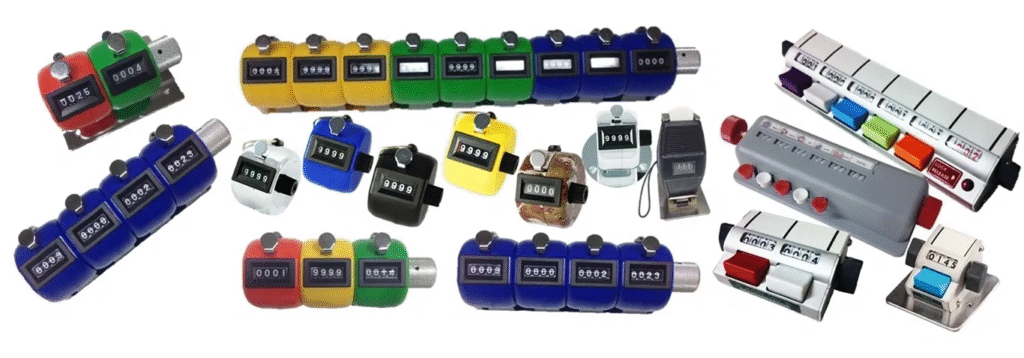
The Birth of the Mechanical Tally Counter
By the 18th and 19th centuries, industries demanded faster and more accurate counting. This led to the invention of the mechanical tally counter.
Key Developments
- Gear-based counting systems
- Push-button operation
- Rotating numeric wheels
Mechanical tally counters quickly became popular in:
- Factories
- Sports events
- Railways
- Census work
These devices allowed thousands of counts in a short time without manual marking.
The Evolution into Digital Tally Counters
With the rise of electronics in the 20th century, tally counters entered a new phase.
What Changed with Digital Counters
- LED and LCD number displays
- Battery-powered operation
- Faster and more accurate counting
- Reset and memory features
These digital tally counters became common in:
- Research studies
- Retail footfall tracking
- Gym training
- Industrial production lines
This was the bridge between traditional mechanical tools and today’s smart counting systems.
The Online and App-Based Tally Counter Era
In the 21st century, tally counters shifted from physical tools to virtual platforms. Today, users can count instantly using browser tools and mobile apps.
For example, online tools like ClickTallyCounter allow users to:
- Track unlimited counts instantly
- Use multiple counters at once
- Save data digitally
- Count without carrying physical devices
This shift reflects how the ancient need to count has adapted to modern technology.
Timeline Summary of the Tally Counter’s History
Here’s a quick breakdown of the major stages:
- 30,000+ years ago: Bone and cave tally marks
- 3000 BCE: Clay token counting in Mesopotamia
- 1000 BCE: Egyptian tally systems
- 1100–1800s: Medieval tally sticks
- 1800s: Mechanical tally counter invention
- 1900s: Digital tally counters
- 2000s–present: Online and mobile tally counters
How the Tally Counter Shaped Modern Data Tracking
The tally counter is the foundation of:
- Attendance systems
- Survey data collection
- Sports scoring
- Inventory tracking
- Behavioral research
Even advanced AI systems still rely on fundamental counting principles developed thousands of years ago.
Practical Lessons from the History of the Tally Counter
The long journey of the tally counter teaches several important lessons:
- Simple tools can survive for centuries
- Accuracy matters more than complexity
- Technology evolves, but the core need remains the same
- Manual methods are still valuable in power-free environments
FAQ: What Is the History of the Tally Counter?
Q1: When was the first tally counter invented?
Tally counting began over 30,000 years ago with bone and cave markings, long before modern devices were invented.
Q2: Who invented the mechanical tally counter?
There is no single inventor, but mechanical counters emerged during the Industrial Revolution to meet factory and census needs.
Q3: Why were tally sticks used in medieval England?
They were used for secure tax and debt recording because splitting the stick made forgery nearly impossible.
Q4: Are modern online tally counters based on ancient methods?
Yes. The principle of one action equaling one count is the same as ancient tally marks.
Q5: Is the tally counter still relevant today?
Absolutely. It is used in education, fitness, research, retail, and digital analytics worldwide.
The Future of the Tally Counter
While the history of the tally counter spans thousands of years, its future is also evolving. Integration with:
- Cloud storage
- Wearable devices
- Smart sensors
- AI analytics
will continue to expand how tally counters are used in research, automation, and real-time data tracking.
Conclusion: A Simple Tool with a Powerful Legacy
So, what is the history of the tally counter? It is the story of human progress—from survival counting on bones to intelligent digital tracking systems. Few tools have remained so relevant across such a massive span of time. If you found this history helpful, share it with others who love learning about everyday tools. You can also try modern counting instantly using ClickTallyCounter and explore how ancient ideas work in today’s digital world.